London Gatwick (EGKK) Pilot Guide
All UK airports in general, but especially Gatwick, Heathrow, and Manchester have very high traffic levels on VATSIM. We appreciate you visiting this page to ensure you are prepared for your flight.
General information
Charts
Its vital that you have access to current navigation charts, as there have been recent changes to the airport layout.
If you don't have a payware chart subscription, you can access free charts from  ChartFox using your VATSIM login.
Scenery
There are multiple up-to-date Gatwick freeware and payware sceneries available.
| Simulator | Payware | Freeware |
|---|---|---|
| MSFS | iniBuilds 2024 | mkvy 2020 & 2024 |
| X-Plane 11/12 | - | mACA454 |
Controller Positions
| RT Callsign | Logon | Frequency |
|---|---|---|
| Gatwick ATIS | EGKK_ATIS |
136.525 |
| Gatwick Delivery | EGKK_DEL |
121.955 |
| Gatwick Planner | EGKK_P_GND |
134.230 |
| Gatwick Ground | EGKK_N_GND |
121.540 |
| Gatwick Ground | EGKK_S_GND |
121.805 |
| Gatwick Tower | EGKK_TWR |
124.230 |
| Gatwick Director | EGKK_F_APP |
118.950 |
| Gatwick Director | EGKK_APP |
126.825 |
Tip
If you are unable to tune an 8.33 kHz frequency in your aircraft, you can tune these frequencies by typing .com1 and the frequency into your pilot client. For example: .com1 121.955
General Advice
If you don't understand an instruction, always ask the controller to clarify rather than do what you think.
When being handed to a new frequency, take 5-10 seconds on new frequency to make sure no one is transmitting or waiting for a response before calling up. In the UK, we call this 'tune, listen, talk':
-
Tune the frequency. Check that the input is correct, and leave time for the software to effect the frequency change. The UK is busy and the network infrastructure can occasionally struggle - frequency changes may not be instantaneous!
-
Listen to the frequency. A controller may be waiting for another pilot to respond while they look something up - pilot responses are not immediate and just because there is 'a gap' does not mean there is room for you to talk! Wait for some time, listen for a couple of transmissions and then...
-
Talk. Think before you speak and be clear about what message you need to give. Avoid rambling, be courteous and speak clearly - needing to repeat a transmission because you spoke too quickly to be heard is always slower than just saying it slowly, once, in the first place.
If you are requested to 'monitor' a frequency, switch to the assigned frequency as soon as practical and do not say anything. The controller will call you up when needed. This may take some time - be patient, comply only with your previously assigned instruction and wait.
If you are told to contact a new controller with "your callsign only", then your initial call should include just that!
Contact with your callsign only
Gatwick Tower, EZY32J
Departure
Clearance
Departure clearance is obtained from Gatwick Delivery EGKK_DEL, or in its absence by the position providing top-down coverage. If Gatwick Delivery is closed, but both Gatwick Ground EGKK_N_GND & EGKK_S_GND positions are open, clearance should be obtained from the position covering your stand as marked on the charts.
At Gatwick, PDC is the preferred method of obtaining clearance. If you are not using the Hoppie's ACARS network, you may be sent a PDC to your pilot client via text. You should not read this back!
If requesting clearance via voice, report:
- Aircraft type
- Stand number
- ATIS
- QNH
All SIDs at Gatwick are runway dependant, thus the runway in use will not be included in departure clearance. You should check the ATIS for the runway in use and check that you have planned and filed the correct SID before calling for clearance.
Warning
You must report fully ready for push via voice to Gatwick Delivery or the position providing top-down coverage, they will hand you to the next appropriate frequecy. Do NOT just switch to ground without being instructed to do se, as your flight may be subject to delay.
Pushback
Warning
Only request pushback when the pushback tug is connected and the aircraft is fully prepared for pushback. If you take more than a minute to start moving ATC may have to cancel your pushback clearance to allow other traffic to pass behind.
Tug release points do not exist at Gatwick. All pushback instructions will contain a direction, and optionally a taxiway/stand to push onto.
Be prepared to comply with non-standard pushback instrucitons:
- Code C (A321/B737) or smaller aircraft on stands 554-562 and even numbered 16-28 stands may be instructed to straight push onto the adjacent taxiway perpendicular to the centerline.
Radiotelephony
EZY32J stand 28 push and start approved, straight push.
- Aircraft may be instructed to push straight back into stands 41-43, 132-133 & 64-66 facing out of the stand.
Radiotelephony
EZY32J stand 23 push and start approved, straight push, into stand 41.
- Aircraft may be instructed to make a long pushback finishing abeam (next to) a stand.
Radiotelephony
EZY32J stand 12 push and start approved, face East, long push abeam stand 18.
Warning
Pilots shall ensure that the aircraft position after pushback is clear of any taxiway intersections.
Taxi out
Gatwick has split ground operations. When in use pilots can expect to be given intermediate taxi instructions to one of the following holding points as shown in the diagram below.
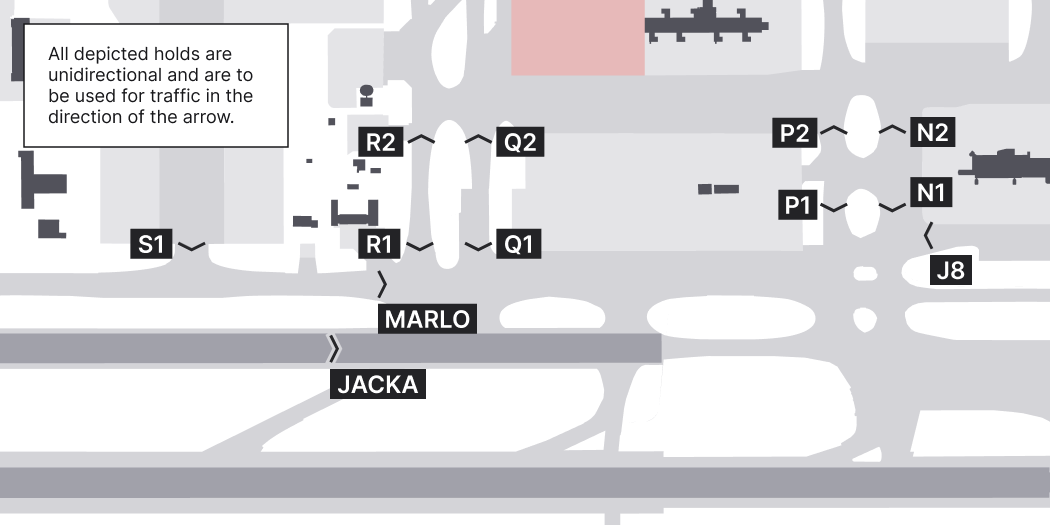
Gatwick Split GMC holding positions
Tip
It is good airmanship to have the next frequency pre-tuned as the ground controller will expect you to keep moving to your previously assigned clearance limit. The faster you get onto the new frequency, the faster we can get you moving!
Warning
When you are instructed to hold short of a Taxiway, do NOT taxi onto it. Ensure there is enough space in front for an aircraft to be able to pass through the intersection.
When the Main Runway 08R/26L is in use (the standad config for Gatwick), the Northern Runway 08L/26R is used and referred to as a taxiway, NOT a runway. You do NOT need additional clearance to enter and taxi on TWY 08L/26R. This information can also be found on the ground charts.
Warning
When in 08R is the active runway, holding point J7 is regularly used for traffic departing south and west. The holding point is located at the end of TWY 26R. You can expect to switch from TWY J to TWY 26R at T.
Warning
When instructed to hold A1/A2/J4/J7 by Ground, do NOT pass the assigned holding point unless further taxi has been issued by the Tower. Do NOT pass the assigned holding point just because the aircraft in front is moving.
Take-off
Pay close attention to the holding point you were assigned by ground. These allow the tower controller to create the most efficient departure sequence. Don't just follow the aircraft in front of you as they may be on a different route!
Once handed off to the tower, switch as soon as possible! This typically occurs around P/N for westerly operations, and passing S on easterly operations.
If you need additional time at the hold, or on the runway for operational reasons, tell the tower controller as soon as possible. Don't wait until you've been cleared to line up or take off, as that will be too late.
To keep traffic moving, expect the use of conditional line-up clearances. These will always be against the next aircraft to use the runway. Once the aircraft has passed in front of you, begin your line-up. The aircraft does not need to have touched down.
Radiotelephony
EZY32J behind the arriving Easy A320 at 5 miles, via A1 line up runway 26L behind
Gatwick operates one of the busiest single runway airports in the world, and as such the tower controller has to make the most use of gaps in arrivals. When you are cleared for takeoff the expectation if you start your takeoff roll immediately.
Your takeoff clearance will include the surface winds, and potentially traffic information that the controller deems pertinent to your flight. You do not need to read back the winds, or every detail about the traffic.
Radiotelephony
ATC: EZY32J, traffic information, a light fixed wing aircraft on the left crosswind, the surface wind 220 degrees at 15 knots, runway 26L cleared for takeoff
Pilot: Visual with the traffic, 26L cleared for takeoff, EZY32J
SID
The airspace around Gatwick is incredibly busy, with many conflicting routes. You must follow the altitude and speed contraints of the SID exactly, otherwise you risk colliding with other traffic.
Warning
You can find all speed restricitons, initial altitudes, and step climbs on the charts. Ensure you study and understand these before departure.
On your first contact with London Control (or Gatwick Director for SFD SIDs), report:
- Callsign
- SID Designator
- Current altitude
- Cleared altitude
Radiotelephony
London Control, EZY32J BOGNA1X, passing 3200', climbing 5,000'
It is very likely you will be vectored off the SID during the initial stages of your flight. Follow each instruction promptly and be ready to rejoin your filed route when directed by ATC.
Tip
You can start turning / climbing while ATC is giving the instruction. You are expected to comply immediately, and do not need to wait to read back before turning.
Arrival
STAR
Altitude constrains noted on the charts are for reference only. Actual descent will be as directed by ATC. You can expect clearances to be level at or abeam a certain fix. Make sure you are able to comply with this in your aircraft, and advise if unable.
Radiotelephony
EZY32J descend FL140 to be level by ABTUM
Warning
Aircraft shall NOT pass the STAR clearance limit ( WILLO / TIMBA ) without clearance from ATC. You are expected to do this by default. ATC may not explicitly tell you to hold.
If further clearance has not been received when reaching the clearance limit, aircraft shall enter the published HOLD procedure as shown on the STAR charts.
| Holding Fix | Inbound Course | Turn Direction | Leg Length | Speed |
|---|---|---|---|---|
| WILLO | 283 | R | 5.1 NM | Max 220 kts |
| TIMBA | 307 | R | 1 min | Max 220 kts |
Tip
It is good airmanship to have the HOLD pre-programmed in the aircraft FMC/MCDU, so that in case ATC does not give you any further instruction the aircraft automatically enters the published HOLD.
Tip
The approach transitions VIA WILLO / TIMBA/ MAY are never issued by ATC. Do NOT program these in the aircraft, a discontinuity after WILLO / TIMBA is normal. Expect radar vectors from WILLO / TIMBA to final.
All planes will be vectored onto the ILS by default. If you require a different approach type inform Gatwick Director EGKK_APP at the earliest suitable opportunity, ideally on initial contact.
Pilots should plan the following speeds unless otherwise instructed. Keep in mind that ATC instructions always take precedent.
-
Below FL100 - 250 KIAS
-
Leaving the hold - 220 KIAS
-
Base - 180 KIAS
-
Established on final - 160 KIAS until 4nm
On first descent to an altitude Intermediate Gatwick Director EGKK_APP will inform you of an estimated track mileage from your current position to touchdown. If online, this will also be updated by the Final Gatwick Director EGKK_F_APP on initial contact, and in both cases does NOT need to be read back. You should use this to calculate and fly a Continuous Descent Approach.
On transfer from the Intermediate Gatwick Director to Final Gatwick Director report ONLY your callsign to them, unless otherwise instructed by the previous controller.
Radiotelephony
Gatwick Director, EZY32J
Due to traffic or airspace constrains it is sometimes necessary to establish aircraft above the platform altitude at 3000' for RWY26L. If this is the case, you will be cleared to establish on the localiser, and then descend ONLY with the glidepath.
Radiotelephony
EZY32J turn left heading 290 degrees, descend altitude 3000', when established on the localiser runway 26L descend with the glidepath.
Landing
Check in with Gatwick Tower EGKK_TWR with your callsign ONLY, unless otherwise instructed by the previous controller.
Radiotelephony
Gatwick Tower, EZY32J
Gatwick operates one of the busiest single runway airports in the world, so the tower controller has to make the most use of gaps in arrivals. There may be one or two departures prior to your arrival, you should not read back that information.
Radiotelephony
EZY32J continue approach RWY 26L, 2 departures ahead, surface wind 120 at 11 knots
It is normal not to receive landing clearance by the approach minimums. You can continue your approach until the moment before touching down without having to go around.
Warning
Not having landing clearance at approach minimus is NOT solely a cause to go around. This will delay you and other pilots.
When the runway is temporarily occupied, a landing clearance may be issued to an arriving aircraft provided that the controller is satisfied that at the time the landing aircraft crosses the threshold, certain criteria will be met.
Landing after a departure
EZY32J after the departing A320, cleared to land runway 26L, surface wind 270 at 9 knots
Landing after an arrival
EZY32J after the landing/vacating A320, cleared to land runway 26L, surface wind 270 at 9 knots
Due to high traffic volume it is imperative you vacate the runway as quickly as possible to avoid go arounds. Plan to use the first available high speed exit.
Tip
You can take the high speed exits at high speeds. (Typically up to 50kts)
Warning
You are not considered vacated until your entire aircraft is passed the appropriate runway holding point.
Taxi in
What to do after landing
- Vacating RET ER: Taxi without stopping first right onto TWY 08L and hold short of JACKA. Do NOT stop until established on TWY 08L.
- Vacating RET FR or GR: Taxi without stopping second right onto TWY J and hold short of MARLO. Do NOT stop until established on TWY J.
- Vacating RET D: Taxi without stopping onto TWY 08L and hold short of TWY Q. Do NOT stop until reaching TWY Q.
- Vacating RET CR: Taxi without stopping onto TWY 08L and hold short of TWY J or AN. Do NOT stop until reaching TWY J or AN.
- Vacating RET BR: Taxi without stopping onto TWY P and hold short of TWY Z. Do NOT stop until reaching TWY Z.
Warning
Aircraft vacating the runway have priority. If taxiing on TWY J or TWY 08R give way to aircraft vacating from the Rapid Exit Taxiways.
Tip
You can request a stand while still in cruise via UKCP