vRIAT | RAF Fairford (EGVA) vRIAT Pilot Brief
Every year, many aviation enthusiasts and aspiring aviators descend upon RAF Fairford, an air base located in Gloucestershire, for the Royal International Air Tattoo. RIAT is billed as the largest military airshow in the world, with air arms from as many as 32 nations attending this year alone. With such a large volume of aircraft arriving and departing Fairford in a short space of time, temporary procedures are introduced at Fairford and surrounding aerodromes, to ensure the safe flow of traffic to and from the show.
An area of Restricted Airspace (Temporary), or RA(T) (pronounced "rat"), is established around the “Fairford Clutch,” this being RAF Fairford (EGVA), RAF Brize Norton (EGVN), and Kemble (EGBP). During the arrival and display days, the RA(T) is split into two parts, North and South of the Cotswold CTA. The Northern portion extends from SFC-FL85, and the Southern portion from SFC-FL65, to coincide with Class A Controlled Airspace above. During the departure phase, a smaller single block of RA(T) is established. This extends from SFC-FL65 and only protects the area around Fairford.
Brize procedures are unchanged, and operational traffic departing RAF Brize Norton is coordinated between Brize and Fairford Radar controllers if required, who are all located in Terminal Air Traffic Control Centre (TATCC) at Brize Norton. However, temporary procedures are introduced at both Fairford and Kemble to facilitate safe operations for aircraft operating at both aerodromes.
Temporary Positions
There are two temporary radar positions available on the network, both using callsign “Fairford Radar” which are EGVA_APP on 123.555, and EGVA_F_APP on 134.555. The Initial Contact Frequency (ICF) for all traffic inbound Fairford is 123.555. Fairford Radar controllers are responsible for traffic arriving and departing Fairford, and the whole RA(T) including the Brize Class D Control Zone, when Brize Zone or Approach are not online. The Brize Control Zone will be treated as Class G when Brize ATC is offline, and therefore a clearance through it is not required.
Other temporary positions that will be open are Fairford Ground (EGVA_GND) on 121.180, and potentially Fairford Delivery (EGVA_DEL) on 130.680. Delivery will only be opened during the departure phase of the event if necessary. Please monitor Fairford ATIS on 135.455 to find out who to contact first. Fairford TWR remains on the standard frequency of 124.800.
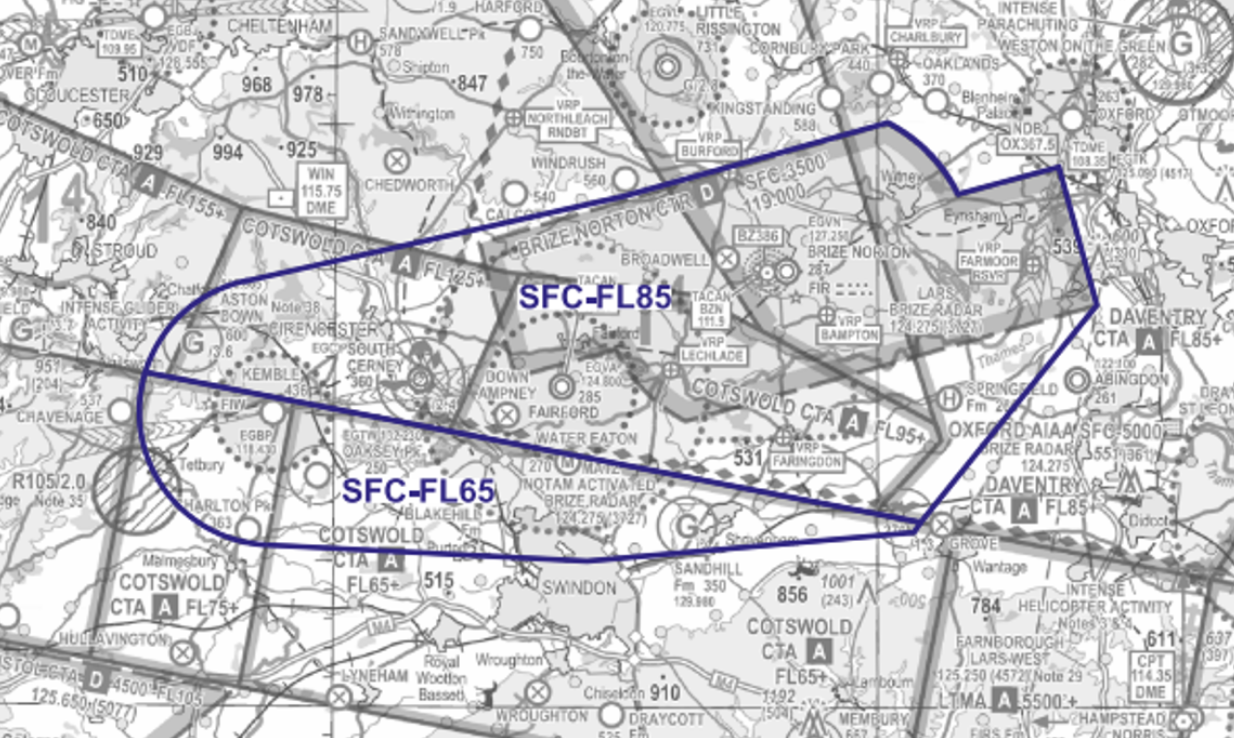
Restricted Airspace (Temporary) - Arrivals and Display
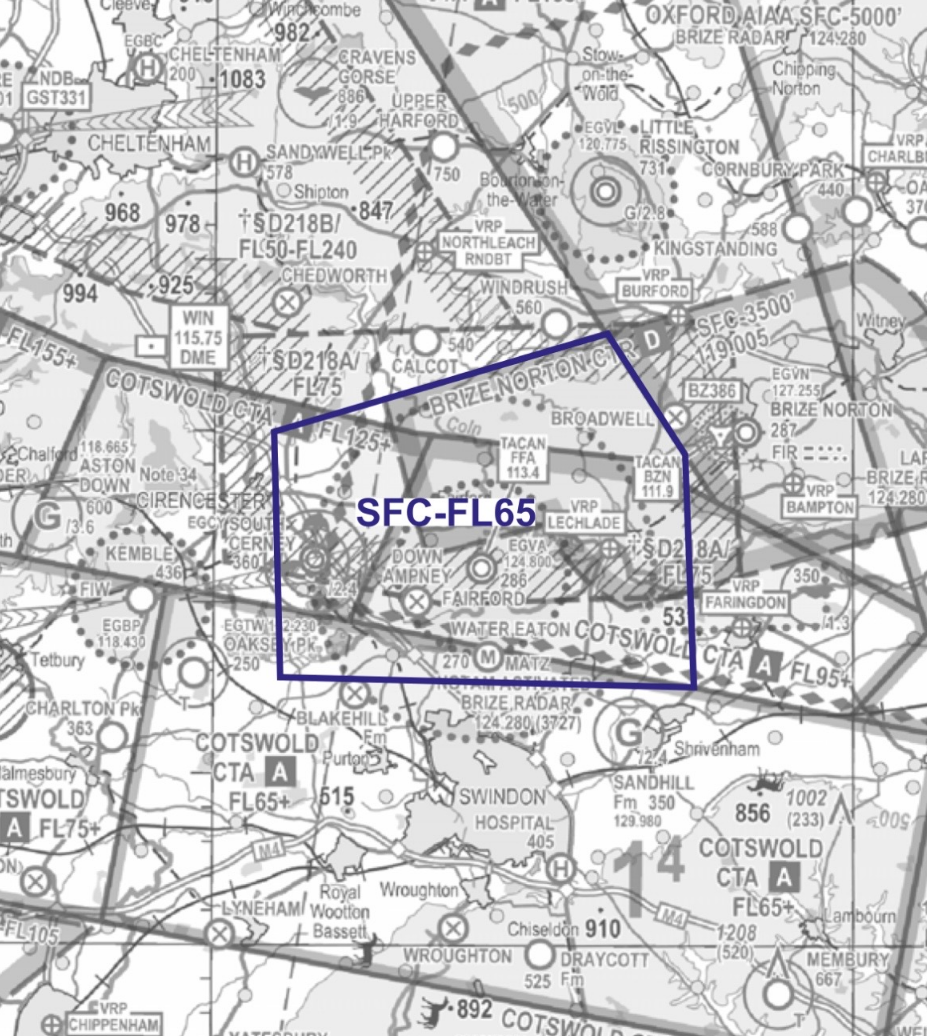
Restricted Airspace (Temporary) - Departures
Fairford VFR Procedures
Arrivals
All arriving VFR traffic shall make initial contact with Fairford Radar (EGVA_APP) on 123.555 at least 20 miles from Fairford.
Traffic arriving VFR into Fairford are subject to different joining procedures based on aircraft type. Fast jets and warbirds can expect to join via Initials (3 miles final) for the active runway, reporting field in sight to Radar, who will hand them off to TWR. Radar may also need to vector fast jets for a visual approach if it is busy so plan for both eventualities. Expect a run-and-break into the circuit. A straight-in approach may be possible if requested early enough. When joining Initials, please use the runway as your line-up reference, as workers and visitors will be close to the Southern edge of the runway. Break altitude is 1500ft.
Slower VFR light aircraft and helicopters will be instructed to join via one of three temporary VRPs: Northleach (to the North), Blakehill Farm (to the Southwest), or Highworth (to the Southeast), not above 1500ft VFR. Radar will hand off to TWR once this traffic is approaching the assigned VRP. Expect to join downwind or base for the active runway, dependant on traffic. You may also be required to hold at your given VRP depending on traffic levels.
The circuit directions during the show are Left-Hand for 09 and Right-Hand for 27, to keep aircraft north of the crowd line. Circuit altitude is 1500ft. Traffic operating within the Fairford visual circuit do not need a clearance to transit Brize Class D Controlled Airspace, provided they are in contact with Fairford TWR or equivalent top-down control.
VFR Missed Approach Procedure
Climb to 1500ft and rejoin the visual circuit
Departures
Traffic departing Fairford VFR are also given different procedures based on aircraft type. Fast jets and warbirds can expect a departure based on a Compass Direction (either north or south), not above 3000ft VFR. Other light aircraft and helicopters can expect to depart via one of the three temporary VRPs: Northleach (to the north), Blakehill Farm (to the southwest), or Highworth (to the southeast), not above 2000ft VFR. All traffic shall contact Fairford Ground (or Delivery if online) for departure clearance.
Your departure frequency will depend on your routing. If departing Fairford VFR via a compass direction, expect to contact Fairford Radar on 123.555 after departure. If you are departing via a VRP, expect to contact 134.555 after departure. The departure frequency will be included in your departure clearance. If required, Fairford Radar will coordinate and issue a crossing of Brize Controlled Airspace for the pilot.
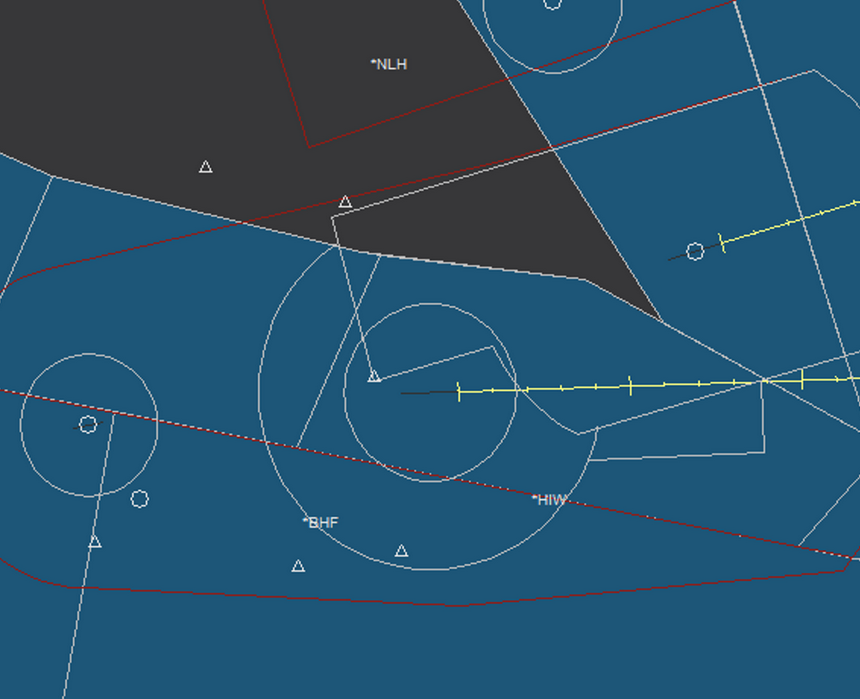
Fairford VRPs
Fairford VRPs (Unabbreviated) from North clockwise to Southwest:
-
NLH = Northleach (Roundabout)
-
HIW = Highworth (Town)
-
BHF = Blakehill Farm (Disused AD)
Fairford IFR Procedures
Arrivals
Traffic arriving IFR will be vectored for a visual approach by default if weather conditions allow. If you require the ILS, please request it with Fairford Radar on initial contact. During periods of reduced visibility, expect an ILS approach.
Inbound IFR traffic is advised to contact Fairford Radar (EGVA_APP) on 123.555 before passing their final flight planned waypoint if inbound via airways, otherwise no later than 20 miles from Fairford if inbound from uncontrolled airspace or a Radar Corridor.
Aircraft inbound from airways are requested to route via CONKO from the West or ASHUM from the East and should expect to route to NAXAT then BZN after these waypoints. For descent planning, expect to be level FL110 by CONKO/ASHUM. Traffic inbound from the north can expect direct BZN after their final waypoint.
All IFR traffic arriving from uncontrolled airspace or a radar corridor can expect a routing to BZN, which gives Brize and Fairford Radar controllers the option to hold IFR traffic if required. Holding instructions vary and will be issued by the appropriate Radar controller. A contingency hold is available overhead the GST NDB (Gloucester) if the BZN hold becomes full. You may also be transferred to Brize Approach when in the hold, if they are online. If holding is not required, expect vectors for your requested approach on handover, and when you are clear of controlled airspace.
BZN hold information:
Inbound course 278°, RIGHT turns, 1 minute legs.
GST hold information:
Inbound course 220°, LEFT turns, 6 mile legs.
The FFA TACAN will not be used for holding due to the large amounts of traffic operating at Fairford, proximity to controlled airspace above, and to keep the overhead clear for Air Displays.
IFR Missed Approach Procedure
Climb on runway track to FL50
Departures
All departing aircraft shall contact Fairford Ground (or Delivery if online) for clearance. Temporary Standard Instrument Departures are introduced for the duration of the show. These SIDs are similar to the US-style Radar Vectored SIDs, where aircraft will initially fly a heading after departure and should expect vectors on course from Fairford Radar when airborne.
SIDs are as follows:
-
Fairford North (departing runway 27): climb on runway track. Initial climb FL50. On passing 2300ft, turn right heading 320 degrees. Expect vectors on course from Fairford Radar.
-
Fairford West (departing runway 27): climb on runway track. Initial climb FL50. Expect vectors on course from Fairford Radar.
-
Lechlade North (departing runway 09): climb on runway track. Initial climb FL50. On passing 2300ft, turn left heading 320 degrees. Expect vectors on course from Fairford Radar.
-
Lechlade East (departing runway 09): climb on runway track. Initial climb FL50. Expect vectors on course from Fairford Radar.
IFR Departure Clearance Example
[Callsign], Fairford North departure. Squawk 1143. Departure frequency when instructed, Fairford Radar on 123.555
Controllers will not clear you to your destination, as you are not cleared into the Airways System until you are airborne. Expect an IFR clearance in the climb from Fairford Radar if London Control is online. If there is no relevant London Control sector online, you will be handed off to Unicom (122.800) prior to entering the confines of controlled airspace.
Airborne IFR Clearance Example
London Control clears [Callsign] to join controlled airspace 4 miles north of CONKO at FL100
You must read this back in full, as it serves as your IFR clearance to your destination.
Note
In real life, squawks are given at the holding point when Brize Radar releases traffic for departure, but thanks to the UK Controller Plugin, these can be assigned straight away and will be included in the departure clearance
Tip
If you are unsure how to fly your assigned SID, please ask! Real pilots do this, and we will happily read the SID out to you if you are unsure!
IFR departures routing via the Airways System are requested to file via CONKO L18 (Eastbound) or CONKO Q63 (Westbound) where possible. Northbound IFR Airways System departures may file via DTY (Daventry VOR) or KISWO, as appropriate.
MAXOB SIDs are unavailable during the show due to increased traffic complexity.
Fairford Ground Procedures
For the purposes of organising traffic, Fairford is divided up into multiple “Aprons” during the show, all of which are assigned a different colour. Arriving aircraft should vacate accordingly and advise which colour apron they will be parking at on first contact with Fairford Ground.
Aprons on the north side are used for display and VIP aircraft, and Aprons on the south side are used for the static display, with the exception of Aprons Red and Green, and the westerly portion of Apron Brown.
In real life, the taxiway designators are also changed, however for the purposes of simplicity in an already complex environment, we will keep them the same as they appear on Aerodrome charts for the duration of the event.
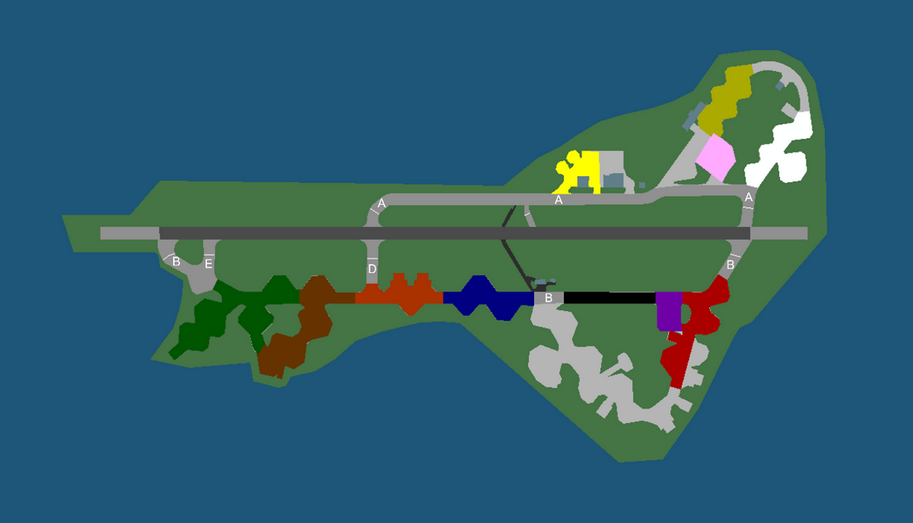
Fairford Ground Layout
Northside Aprons (from left to right):
Yellow, Pink, Gold, White
Southside Aprons (from left to right):
Green, Brown, Orange, Blue, Black, Purple, Red
All aprons are referred to as "Apron [colour]" e.g.
Radiotelephony
GRIFFIN 53, taxi Apron Orange
Holding points will be given with the runway number eg
Radiotelephony
TESTER 21, taxi holding point B for runway 27
Please pay attention to the runway given in the taxi instruction, as both main taxiways meet the runway at both their respective ends.
Taxiway C is closed and will not be used during this event. It is therefore not labelled on the diagram above.
Kemble Temporary Procedures
Due to Kemble’s proximity to Fairford, it is included within the RA(T). Therefore, defined procedures are set out for pilots wishing to operate into or out of Kemble. These come in the form of four standard VFR routes; each assigned a colour. These routes are:
-
Green (via Chedworth Disused AD)
-
Red (via M4 Junction 16)
-
Yellow (via M4 Junction 17)
-
Blue (via Dursley)
A clearance to use these routes is required from Brize Zone (or Approach if Zone is offline). In the absence of a Brize Approach controller, a clearance can be obtained from Fairford Radar on 123.555.
On initial contact, pilots shall advise Kemble AFIS which route they would like to take, and Kemble AFIS shall coordinate with Brize Zone. In the absence of Kemble AFIS, please call Brize Zone/Approach or Fairford Radar on 123.555 before getting airborne, or prior to leaving the Kemble ATZ, for a clearance to leave the RA(T). A clearance will be issued prior to departure, which will sound like this:
Radiotelephony
[Callsign] leave the RA(T) (pronounced “rat”) via the Red Route, not above altitude 1500ft VFR, squawk 3717. Next frequency when instructed Brize Zone on 119.005
Arriving traffic shall contact Brize Zone/Approach or Fairford Radar in good time to ensure a clearance can be issued. An entry clearance will sound like this:
Radiotelephony
[Callsign], enter the RA(T) (pronounced “rat”) via the Blue Route, not above altitude 2500ft VFR, squawk 3717
Circuit traffic at Kemble shall squawk 7010 and shall inform Kemble AFIS in good time if they wish to depart the circuit, so that Kemble AFIS can coordinate a clearance with Brize Zone/Approach or Fairford Radar.
Please note that clearances may be withheld if traffic volume is too high within the RA(T), although this is unlikely on the network.
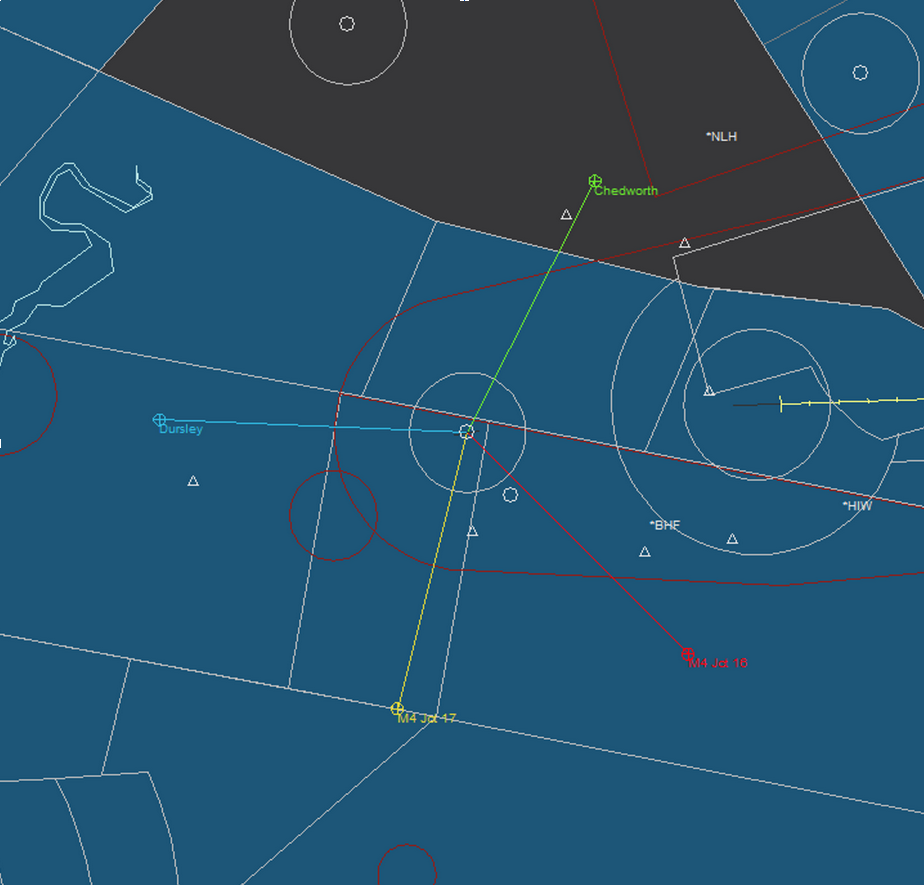
Kemble Procedures
Any errors in this documentation should be reported to [email protected]