vRIAT | RAF Fairford (EGVA) vRIAT Controller Brief
This document provides Virtual Royal International Air Tattoo (vRIAT) controllers a briefing on procedures associated with the event. Controllers are encouraged to read all sections to ensure they are aware of the responsibilities of all adjacent positions for this event. Display-specific procedures are located in the DSP section of this document, located below the GEN, ADC and APC sections.
GEN
Altimeter Setting Procedures
Since Fairford ATC is operated by the US Air Force outside of the show period, Fairford METARs report QNH in Inches of Mercury (inHg) rather than Hectopascals (hPa). Controllers may elect to convert between inHg and hPa at their discretion.
If using inHg, QFE is calculated by subtracting 0.30 inHg from the QNH eg. A2992 (29.92 inHg) QNH would give a QFE of 29.62 inHg. If controllers elect to use hPa, QFE is calculated by subtracting 10 hPa from the calculated QNH.
The live QNH and Altimeter setting can be found here.
Restricted Airspace (Temporary)
Restricted Airspace (Temporary) will be in effect for the duration of vRIAT ATC staffing hours to protect the airspace surrounding the event. There are two different RA(T)s that will be in use: one for the arrivals and display phases, and an RA(T) of reduced dimensions for the departures phase. Both RA(T)s have selectable displays in EuroScope. These should automatically be activated and deactivated by the TopSky plugin during event hours. These can also be found in the Display Settings > ARTCC menu in the event that the TopSky automatic display function fails. Diagrams of the Restricted Airspace (Temporary) arrangements for vRIAT are included below.
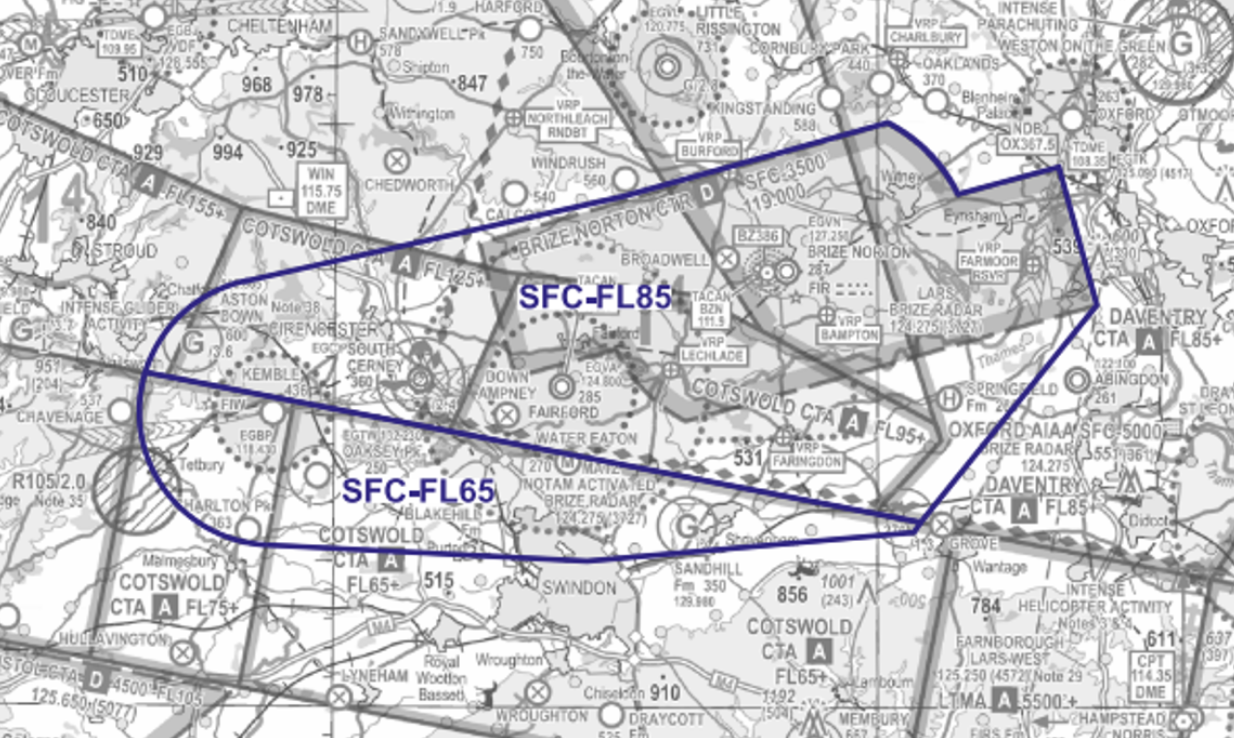
Restricted Airspace (Temporary) - Arrivals and Display
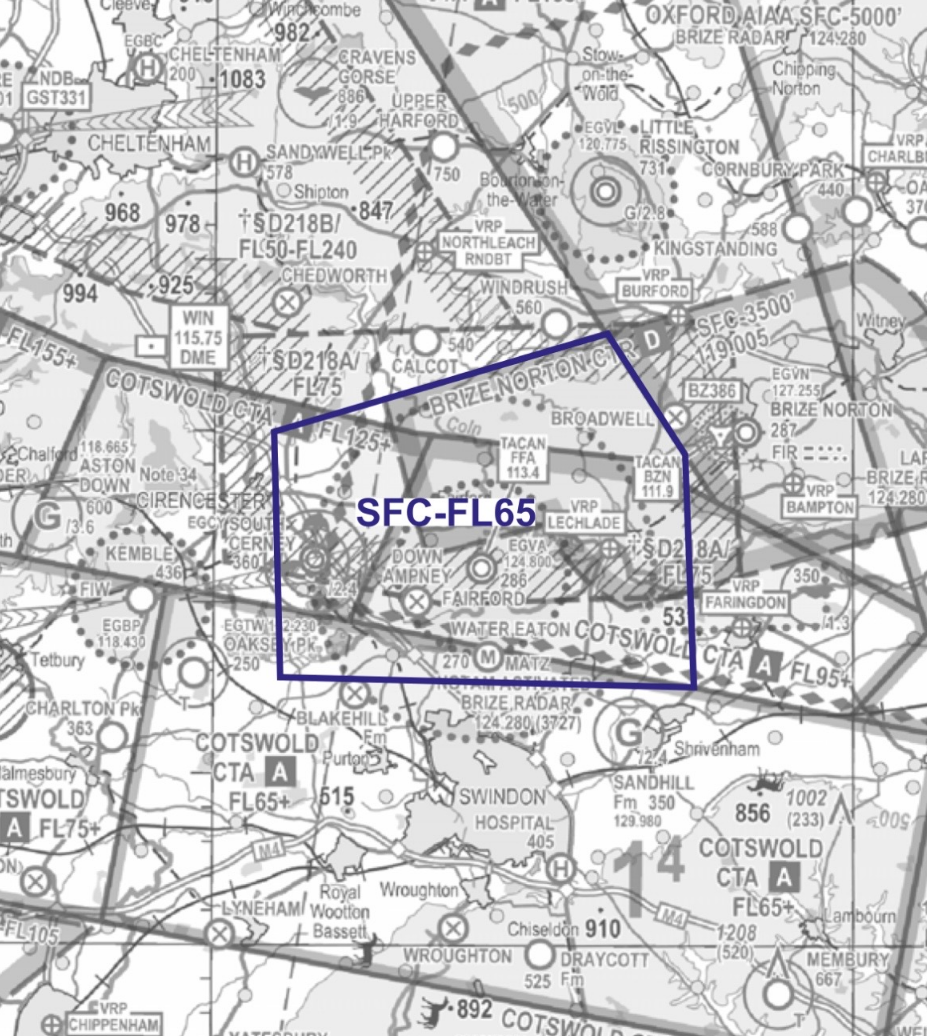
Restricted Airspace (Temporary) - Departures
SSR Code Assignment
Squawk Allocation: 6001-6017
-
6007is used for VFR traffic arriving and departing Fairford via a VRP, and departures routing to display holds during the display -
6010is used for VFR departures not above 3000ft via a Compass Direction -
6017is used for the Skyvan Photoship (if operational). Available for normal allocation during the display and departures phase
Temporary VRPs
Three Temporary VRPs are established for vRIAT:
-
Northleach (North)
-
Highworth (Southeast)
-
Blakehill Farm (Southwest)
VFR holding shall be conducted not above 1000ft QNH, avoiding built-up areas. Departing VFR traffic shall be informed of VFR holds if active.
A diagram of the VRPs is provided below.
-
NLH is the Northleach VRP
-
BHF is the Blakehill Farm VRP
-
HIW is Highworth VRP
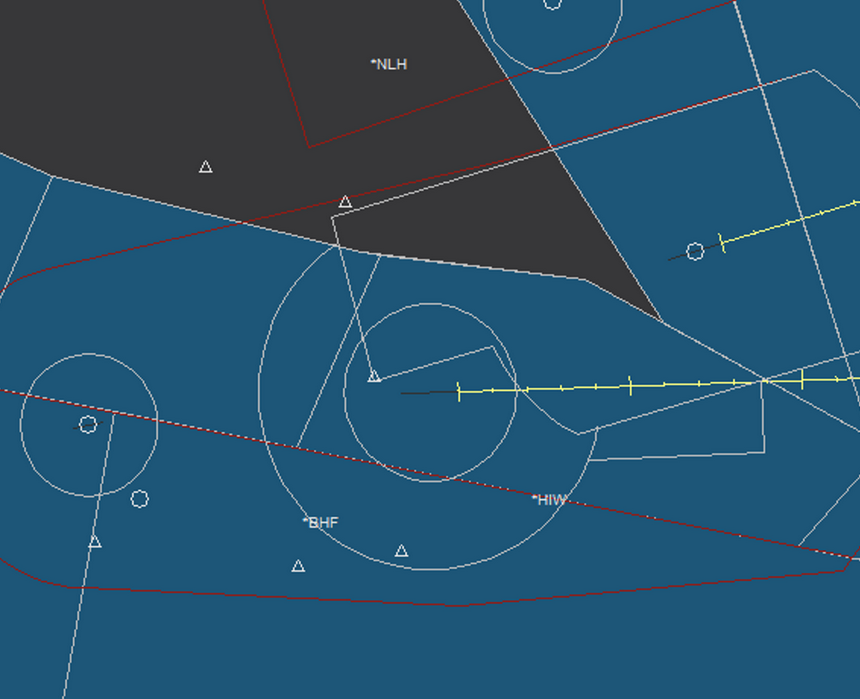
Fairford VRPs
Temporary SIDs
Temporary SIDs are established for vRIAT. These SIDs are similar to the US-style Radar Vectored SIDs, where aircraft will initially fly a heading after departure and can expect radar vectors on course when airborne. Details of these Temporary SIDs can be found below.
09 SIDs
-
Lechlade North - Fly runway track. On passing 2300ft, turn left heading 320 degrees. Climb FL50.
-
Lechlade East - Fly runway track. Climb FL50.
27 SIDs
-
Fairford North - Fly runway track. On passing 2300ft, turn right heading 320 degrees. Climb FL50.
-
Fairford West - Fly runway track. Climb FL50.
Departure Releases
| Departure | Release | Prenote |
|---|---|---|
| IFR Departures | RAD 1 Provide Callsign and SID |
|
| VFR Departures via a Compass Direction | RAD 1 Provide Callsign, Aircraft type, and Direction |
|
| VFR Departures via a VRP | RAD 2 Provide Callsign, Aircraft Type, and VRP |
|
| Departures Routing to a Display Hold | RAD 1 Provide Callsign, Display Hold, and Departure Method |
Missed Approach Procedures
VFR traffic shall climb to altitude 1500ft and rejoin the visual circuit. Traffic shall remain with TWR. No coordination is required.
IFR traffic shall fly runway track and climb FL50. TWR shall coordinate missed approach traffic with (and transfer to) Fairford RAD 1.
ADC
GND
Fairford Ground operates on 121.180.
Clearance Delivery
Aircraft may call for clearance up to 30 minutes prior to their departure time. IFR departures shall depart via a Temporary SID. Fairford or Lechlade North SIDs shall be given to aircraft joining the ATS Route Network, and Fairford West or Lechlade East departures shall be given to all other IFR departures.
IFR departures joining the ATS Route Network shall be allocated a UKCP squawk. IFR departures routing via the Military Route Network shall be allocated a squawk from the range 6001-6017 (excluding 6007 & 6010).
Radiotelephony
Czech Air Force 419, Fairford Ground, Fairford North departure. Departure frequency when instructed: Fairford Radar on 123.555. Squawk 5213
Traffic may be unfamiliar with the Temporary SIDs if they have not read the briefing. In this case, GND shall provide the full SID instructions over RT. A full description of the SIDs can be found in the SIDs section of this document.
GND shall issue a Departure Warning (prenote) to London AC West (if online) when traffic joining the ATS Route Network at CONKO requests start.
VFR departures shall be assigned a VRP or Compass Direction for departure, depending on aircraft type and performance. Light aircraft and helicopters shall depart via a VRP and shall be instructed to maintain VFR not above 1500ft and squawk 6007.
Radiotelephony
Black 01, after departure, leave the RA(T) via the Blakehill Farm VRP, not above altitude 1500ft VFR. Departure frequency when instructed, Fairford Radar on 134.555. Squawk 6007
High performance aircraft and warbirds shall depart via a specified Compass Direction (North or South) and shall be instructed to maintain VFR not above 3000ft and squawk 6010.
Radiotelephony
Tennis 1, after departure, route Northbound to leave the RA(T), not above altitude 3000ft VFR. Departure frequency when instructed, Fairford Radar on 123.555. Squawk 6010
In the event that GND becomes too busy to perform the clearance delivery function (during the departures phase of the event only), Fairford DEL may be opened on 130.680.
Ground Movement
For the purposes of organising traffic, the airfield is divided up into multiple “Aprons” during the show, all of which are assigned a different colour. Arriving aircraft shall vacate accordingly and advise which Apron they will be parking on during first contact with GND.
Aprons on the North Side are used for display and VIP aircraft, and Aprons on the South Side are used for the static display, with the exception of Aprons Green and Red. All aprons are referred to as "Apron [colour]" over RT eg.
Radiotelephony
GRIFFIN 53, taxi Apron Orange
In real life, the taxiway designators are also changed, however for the purposes of simplicity in an already complex environment, taxiway designators shall remain the same as they appear on the standard Aerodrome charts for the event. Holding points will be given with the runway number eg.
Radiotelephony
TESTER 21, taxi holding point B for runway 27
Taxiway C is closed for the event
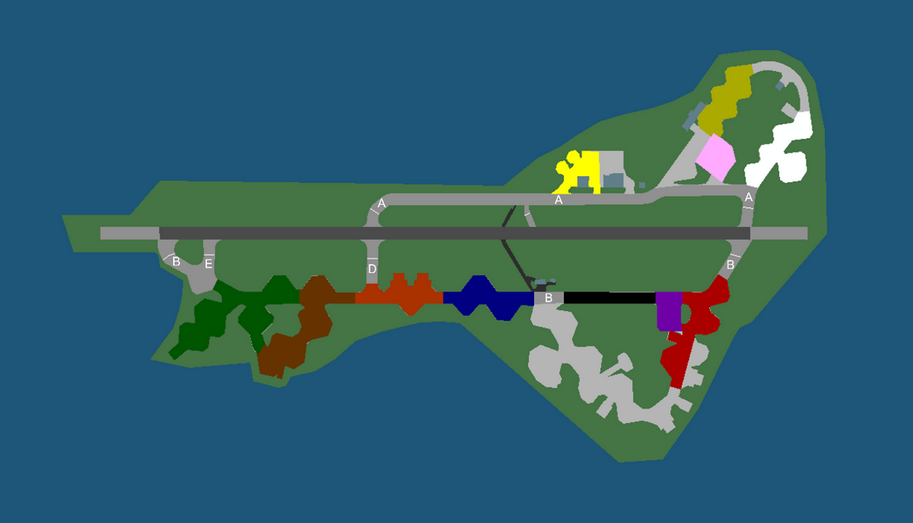
Fairford Ground Layout
Northside Aprons (from left to right):
Yellow, Pink, Gold, White
Southside Aprons (from left to right):
Green, Brown, Orange, Blue, Black, Purple, Red
TWR
Fairford Tower operates on 124.800.
Runway & Circuit Procedures
The preferred runway when the tailwind component is 10 knots or less is runway 27. Circuits shall be conducted to the north of the airfield at 1500ft Fairford QNH. Runway 09 is a left-hand circuit and runway 27 is a right-hand circuit.
RAD 1 shall prenote TWR on inbound traffic, providing callsign, aircraft type and whether the traffic is going to the Photoship before arrival. RAD 2 shall provide TWR with a 10 NM range check on all IFR inbounds, irrespective of approach type.
Fast jets may request to join for an overhead break via initials (a point at 3 NM on the final approach track). Traffic shall “request join” on handover from RAD 2. This shall be approved and the overhead break is conducted at circuit altitude. Pilots do not need to report on the break but shall report final.
Radiotelephony
Javelin flight, Fairford Tower, join approved for runway 27, report initials
Light aircraft and helicopters shall join via downwind or base and may join from any direction, remaining clear of the airfield boundary until turning final. Alternatively, inbound VFR traffic may be instructed to hold at their designated VRP during high periods of traffic.
Formations of a single aircraft type shall be referred to over RT as “[Callsign] flight,” whereas formations of multiple types shall be referred to as “[Callsign] combine.” Trailing formation aircraft shall be cleared to land in turn with an advisory of the number of aircraft on the runway.
Radiotelephony
Javelin 12, runway 27, cleared to land, one on
Helicopters may be cleared to land on the runway threshold and vacate immediately left or right to expedite traffic flow.
Pilots of aircraft with retractable landing gear shall confirm landing gear position when reporting final. If the pilot doesn't confirm landing gear position, instruct them to check gear.
Radiotelephony
Belgian Air Force 319, check gear down
Departure Handoffs
TWR shall hand off departures as described below
RAD 1 (123.555)
-
All IFR departures (release required from RAD 1)
-
VFR departures via a Compass Direction not above 3000ft
RAD 2 (134.555)
- VFR departures via a VRP not above 1500ft
APC
RAD 1
Fairford RAD 1 (callsign “Fairford Radar”) operates on 123.555. It is the Initial Contact Frequency (ICF) for all traffic inbound to vRIAT. The logon callsign EGVA_APP shall be used for RAD 1. The coordination callsign for this position is “Radar 1.”
Arrivals
RAD 1 provides initial sequencing of IFR traffic inbound to Fairford. Traffic Service shall be the default FIS provided to IFR traffic due to high traffic density. Deconfliction Service may be provided subject controller workload, but only if pilots specifically request it. VFR traffic shall be provided with a Basic Service.
Where possible, traffic shall be vectored for a visual approach. In cases where this is not possible, due to weather for example, an ILS approach is to be expected. Larger aircraft such as transport or support planes may request an ILS approach and this shall be provided where possible.
Approach type shall be conveyed through the use of the scratchpad. /ILS or /VIS shall be inserted to indicate whether the aircraft is requesting an ILS or Visual approach, respectively. This reduces coordination between RAD 1 and RAD 2.
RAD 1 also approves VFR inbounds to enter the vRIAT RA(T). VFR arrivals shall request to enter the RA(T) via one of the Temporary VRPs. Traffic shall be transferred to TWR no closer than 5 NM from the aerodrome. VRPs may be indicated in the scratchpad using /HIW for Highworth, /NLH for Northleach, and /BHF for Blakehill Farm. An example of an approval to join the RA(T) is included below.
Radiotelephony
Bladeslap 1, Fairford Radar, join approved via Highworth, not above altitude 1500ft VFR. Report approaching Highworth
All arrivals shall be prenoted to TWR, stating Callsign, Aircraft Type and whether the aircraft will be joining up with the Photoship before its arrival.
Holding
RAD 1 is responsible for holding at BZN TACAN. Brize APC may also manage the BZN hold if online.
BZN Hold details: BZN 278° inbound, RIGHT turns, 1 minute legs, FL60-FL100.
FFA TACAN shall not be used as a holding facility.
The Malvern Hold (located overhead GST NDB) is also available for use as a contingency hold.
Malvern Hold details: GST 220° inbound, LEFT turns, 6 NM legs, FL110-FL140.
Departures
RAD 1 is responsible for IFR departures. TWR will call for release stating Callsign and SID.
Traffic joining the ATS Route Network shall be cleared to enter Controlled Airspace 4 NM North of waypoint CONKO at FL100, or if filed via DTY or KISWO, coordination shall be effected with the appropriate London Control Sector to obtain a clearance.
RAD 1 is also responsible for VFR departures departing via a Compass Direction. These aircraft will wear squawk 6010 and shall be provided with a Basic Service. These departures shall be instructed to maintain VFR not above 3000ft.
RAD 2
Fairford RAD 2 (callsign “Fairford Radar”) operates on 134.555. The logon callsign EGVA_F_APP shall be used. The coordination callsign for this position is “Radar 2.”
RAD 2 provides final approach sequencing for IFR inbounds.
RAD 2 also serves as the departure controller for low-level VFR traffic during the departures phase of the event. This position is only used if required during the display.
Arrivals
Visual approach shall be the default approach type, however larger aircraft such as transport or support planes may request an ILS approach and this should be accommodated where possible. IFR traffic shall be sequenced to achieve 8-10 NM final approach spacing. This allows traffic to cross or backtrack if required, and should provide sufficient gaps for VFR inbounds to land and vacate.
Approach type shall be conveyed through the use of the scratchpad. /ILS or /VIS shall be inserted to indicate whether the aircraft is requesting an ILS or Visual approach, respectively. This reduces coordination between RAD 1 and RAD 2.
RAD 2 shall provide TWR with a 10 NM range check on all IFR inbounds, irrespective of approach type.
Departures
RAD 2 is responsible for low level VFR departures via Northleach, Blakehill Farm and Highworth during the departure phase only, in addition to providing final approach sequencing to inbound aircraft. Departing VFR traffic shall be provided with a Basic Service until clear of the RA(T). LARS may be provided up to a range of 30 NM, subject controller workload.
DSP
Display Callsigns
Aircraft may elect to use a display callsign to distinguish themselves from other aircraft of the same type, or for simplicity eg. “Polish MiG.” The pilot may notify GND via Private Message or on initial contact. GND shall take note of this and write it in the aircraft’s scratchpad in EuroScope. Display teams may use their team name as a callsign. Standard callsigns are also allowed for display aircraft.
Display Holds
There are two display holds available during the show. One overhead the BZN TACAN, and another over Water Eaton (solar farm 3NM South of Fairford).
Traffic holding in one of the designated display holds shall be transferred off the TWR frequency prior to the beginning of a display. The default frequency for display holds is RAD 1 on 123.555, however in the event that this frequency is occupied, traffic in the Water Eaton display hold may be transferred to the Fairford GND frequency on 121.180 until such a time that the TWR frequency is available again. TWR shall coordinate this arrangement with GND when required.
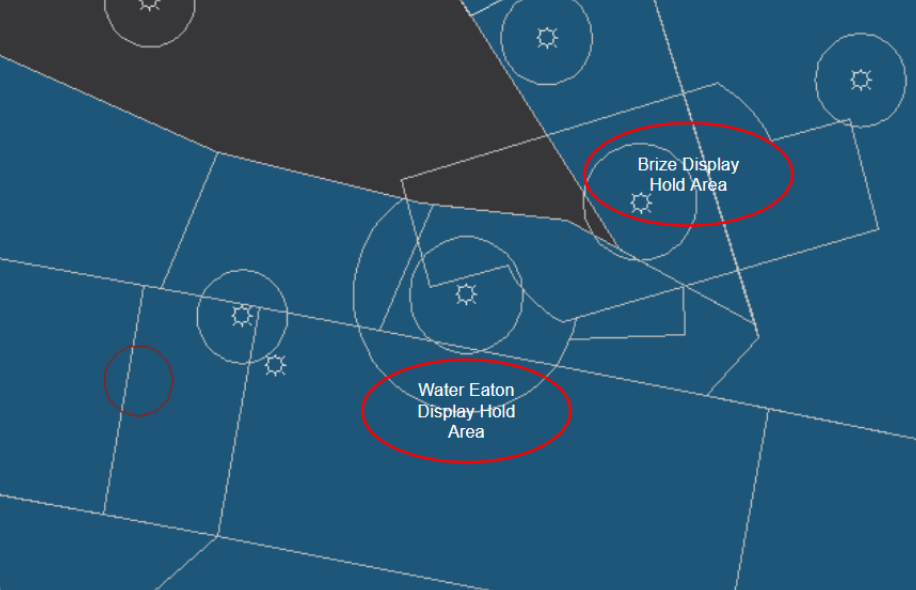
Display Hold Areas
Fairford GND
Display aircraft may call for start up to 30 minutes prior to their display slot. Irrespective of whether the aircraft has provided the correct ATIS code, GND shall provide the runway in use, QNH, QFE and display progress (whether the display is early, on time, or delayed). Display delay shall be provided in number format, with “display plus [number]” being behind schedule and “display minus [number]” ahead of schedule, otherwise the phrase “display on time” shall be used. The display squawk of 7004 shall also be assigned on start.
Radiotelephony
Swedish Gripen, Fairford Ground, start approved. Runway 27. QNH 1013, QFE 1003. Squawk 7004. Display plus 5
GND may also request details on the maximum display height and radius.
Radiotelephony
Swedish Gripen, confirm maximum height and radius of display
GND shall take note of these parameters and if the maximum height is above 5000ft, the aircraft shall be instructed to perform all manoeuvres North of the runway. This is due to the proximity of Controlled Airspace above and to the South of Fairford.
Aircraft shall be instructed to monitor TWR on handover. They may also be reminded that TWR will call them.
Radiotelephony
Dutch F-16, monitor Fairford Tower on 124.8. They will call you
Traffic may need to backtrack during other displays to return to their original parking position. TWR will ask the next display item if they are happy for this to happen, and will advise GND. The backtracking aircraft shall be retained on the GND frequency.
Airborne aircraft holding at the Water Eaton display hold may be transferred to GND frequency to keep TWR frequency clear for displays, but only if the RAD 1 frequency is already in use for aircraft in a display hold. TWR shall coordinate this arrangement with GND when required.
Fairford TWR
The Fairford TWR frequency is the designated display frequency and shall be kept clear during displays to allow formations to coordinate manoeuvres if they have no discrete frequency. Traffic transferred from GND shall be instructed to monitor the TWR frequency on handover.
Traffic departing for a display hold shall be individually coordinated with RAD 1 who will provide a full clearance. This may be via a SID or own navigation to the Display Hold.
Prior to RAD 1 transferring display traffic to TWR, they shall instruct the traffic to squawk 7004.
When a displaying aircraft is cleared for takeoff, the phrase “Cleared for takeoff and display” shall be used. After the pilot has acknowledged the clearance, radio silence shall be implemented. Display traffic that is already airborne shall simply be “Cleared for display” when the display area is sterile. Airborne traffic may also be asked to report running in.
From the ground
Krila Oluje, runway 27, surface wind 230, 8 knots. Cleared for takeoff and display
From the air
Memorial flight, surface wind 290, 11 knots. Cleared for display. Report running in
Traffic holding short of the runway will be instructed to monitor TWR when transferred from GND when a display is in progress. When a display reports “display complete,” radio silence shall be terminated and normal operations may resume until the next display item is cleared to display.
Traffic landing after a display shall be instructed to vacate via Taxiway A where possible, if parked on Aprons Gold, White, Pink or Red. In the event that traffic misses Taxiway A, or they are parked on Aprons Green or Brown, they shall be instructed to vacate via Taxiway E and turn right onto Taxiway B and hold short of the runway. Traffic shall be transferred to GND once vacated.
If an aircraft needs to backtrack the runway to return to its parking position, the Pilot in Command of the next display shall be asked if they are happy for the aircraft to do so during their display. If they don’t require use of the runway for their display then this shouldn’t be an issue, however if it is known that a display item will require use of the runway during their display, traffic shall hold short until the display sequence is complete. This traffic shall be retained on the GND frequency during the backtrack.
Fairford RAD 1
RAD 1 is the primary display hold frequency. TWR shall individually coordinate a departure clearance for traffic departing to a Display Hold. This shall include a routing (SID or own navigation) and a squawk. TWR shall transfer traffic to RAD 1 when airborne. Traffic shall be given own navigation to either of the display holds (if not already given) at the BZN TACAN or Water Eaton. The BZN TACAN hold is the preferred display hold and shall be the first hold to be used.
Aircraft may use RAD 1’s frequency to coordinate formation joins so RT time shall be kept to a minimum. This traffic shall wear squawk 6007 and shall be provided with a Basic Service unless otherwise requested. Display traffic shall be instructed to squawk 7004 prior to transfer back to TWR.
RAD 2 is not in use during the display, but remains available if required.
Kemble Temporary Procedures
Due to Kemble’s proximity to Fairford, it is included within the RA(T). Therefore, defined procedures are set out for pilots wishing to operate into or out of Kemble. These come in the form of four standard VFR routes; each assigned a colour. These routes are:
-
Green Route (via Chedworth Disused AD)
-
Red Route (via M4 Junction 16)
-
Yellow Route (via M4 Junction 17)
-
Blue Route (via Dursley)
A clearance to use these routes is required from Brize ZONE (or Brize APP if ZONE is offline). In the absence of Brize APC, traffic shall obtain a clearance from RAD 1.
On initial contact, pilots shall advise Kemble AFIS which route they would like to take, and Kemble AFIS shall coordinate with Brize ZONE. In the absence of Kemble AFIS and Brize APP/ZONE, pilots shall call Fairford Radar on 123.555 before getting airborne, or prior to leaving the Kemble ATZ, for a clearance to leave the RA(T). A clearance will be issued prior to departure or leaving the Kemble ATZ. An example can be found below:
Radiotelephony
[Callsign], leave the RA(T) via the Red Route, not above altitude 1500ft VFR, squawk 3717. Next frequency Brize Zone on 119.005
Arriving traffic shall contact Brize APP/ZONE in good time to ensure a clearance can be issued. An example of an entry clearance can be found below:
Radiotelephony
[Callsign], enter the RA(T) via the Blue Route, not above altitude 2500ft VFR, squawk 3717
Circuit traffic at Kemble shall squawk 7010 and shall inform Kemble AFIS in good time if they wish to depart the circuit, so that Kemble AFIS can coordinate a clearance with Brize ZONE/APP or Fairford Radar.
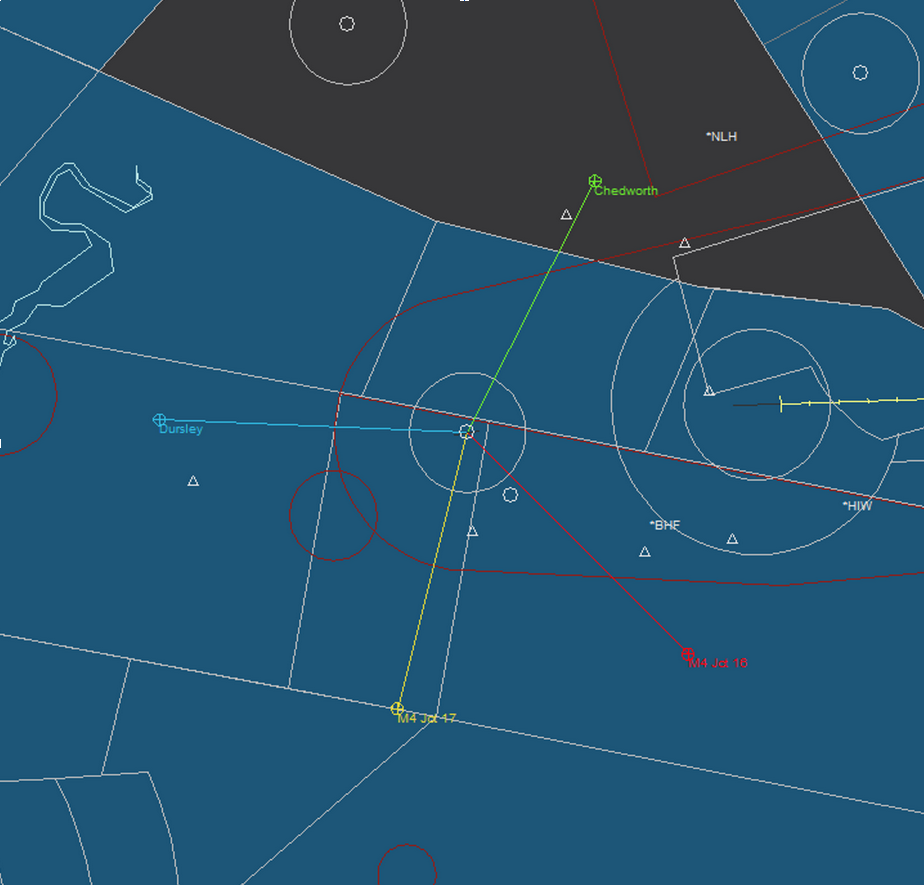
Kemble Procedures