Pilot Briefing - London Heathrow
Getting Ready
Cross the Pond is one of the most popular events on VATSIM. Every year, thousands of pilots and hundreds of Air Traffic Controllers come together to staff dozens of positions to provide pilots with a full ATC service to cross the Atlantic Ocean. The event takes place on an alternating basis, either Eastbound or Westbound.
Crossing the Pond is an aviation challenge, particularly for aircraft crewed by a single pilot. It is a busy event; controllers and pilots alike will be incredibly busy. VATSIM UK provides this to help you understand:
- How to prepare for your flight in advance
- What to expect from our en-route controllers
- What to expect arriving into Heathrow.
We hope that you have great fun flying for Cross the Pond. It's a fantastic event that shows the best of VATSIM - but just a few minutes of preparation on the day and some carefully planning in advance can help everyone make the most of it. Remember that:
- You are responsible for the safe operation of your aircraft.
- You may be expected to perform unusual procedures, or do things that you may do infrequently. These may include en-route holding, non-standard holds at a terminal fix, or flying headings through congested airspace. Even putting an Oceanic flight plan into your aircraft may be more complicated than you think!
- Your autopilot is not in charge; you are! If a controller provides an instruction, even one which seems unusual, you must co-operate promptly, even if this means disabling the autopilot temporarily. Chose your aircraft carefully - Cross the Pond is not the time to be experimenting with something new!
- Practice makes perfect! It's not too late to learn how to Cross the Pond before the event!
Updates on the Day
If you haven’t already done so, please join the VATSIM UK Discord server to receive event updates in the #pilot_notams channel.
Non-event Traffic
It is very common for pilots that cannot fly for the full duration of the event to make use of the broad ATC coverage, either by flying into or from Europe or flying UK domestic flights. Whilst it's always great to welcome pilots into the UK's airspace, please remember that this is a busy event and our controllers will already be under strain.
Pilots are welcome to try to fly, but please remember that:
- Flow management measures will be in place throughout the event. Compliance with these is required by the VATSIM Code of Conduct
- Our controllers will be very busy and are highly likely to be able to accommodate unusual requests like full procedure approaches or joining controlled airspace from quiet departure aerodromes
- Avoiding flow measures by departing uncontrolled airports is selfish and deliberately disruptive to events. Our controllers will try to be accommodating, but please consider your plans carefully.
AIRAC Navigation Data
According to the VATSIM Code of Conduct, you must be able to fly up to date procedures. You should update the AIRAC navigation data of addon aircraft and flight planning software prior to CTP to avoid any issues on the day.
Note
Cross the Pond takes place on the 26th of April. There was last an update to AIRAC data on the 17th of April - you must ensure you update your navigation data before the event.
Charts
It’s vital that you have access to current navigation charts both for your crossing of "the pond", and for your arrival into Heathrow.
If you don’t have a payware chart subscription, you can access free charts from  ChartFox using your VATSIM login.
Scenery
We recommend installing up-to-date Heathrow scenery to avoid any confusion when taxying on arrival.
| Simulator | Payware | Freeware |
|---|---|---|
| MSFS | iniBuilds 2024 iniBuilds 2020 |
- |
| xPlane 11/12 | Origami | - |
Aircraft
Cross the Pond is one of the busiest events on the VATSIM network. Controllers will often be busy and unable to help resolve issues with your aircraft. As outlined in the Code of Conduct Section B - it is vital you select an aircraft you are familiar with operating, and which has a well-functioning FMC. You should be comfortable hand flying the aircraft in case that you need to.
Do not leave it until the last minute - you must ensue that both you and your aircraft are capable of:
- Configuring an Oceanic flight plan
- Configuring and flying an en-route hold
- Changing the STAR from your planned route - even if you're already on the STAR
- Setting a 'direct to'
- Coming off-route and flying an assigned heading
- Returning to your planned route
- Configuring and flying a terminal hold
- Descending within the hold
Frequency Management
Please note that many of the frequencies below use 8.33 kHz spacing. If you are unable to tune an 8.33 frequency in your aircraft, you can tune these frequencies by typing .com1 and the frequency into your pilot client. For example: .com1 121.705
If using the latest version of vPilot or xPilot, you can also right click on a controller in the frequency list and select Tune XXX.XXX on COM 1.
Frequency List
Below are a set of standard frequencies you can expect arriving into Heathrow; note that on the day, you may be directed to a different frequency, some of which may not be listed here. Listen to the controllers and if you are unsure, ask rather than guessing.
Area Control Positions
| Logon Callsign | Radiotelephony Callsign | Frequency |
|---|---|---|
| SCO_CTR | Scottish Control | 125.680 |
| SCO_BDS_CTR | Scottish Control | 135.530 |
| SCO_WB_CTR | Scottish Control | 133.875 |
| SCO_S_CTR | Scottish Control | 134.775 |
| LON_CTR | London Control | 127.830 |
| LON_W_CTR | London Control | 126.080 |
| LON_N_CTR | London Control | 133.705 |
| LON_NW_CTR | London Control | 135.580 |
| LON_C_CTR | London Control | 127.105 |
| LON_M_CTR | London Control | 120.025 |
| LON_S_CTR | London Control | 129.430 |
| LON_H_CTR | London Control | 134.440 |
| LTC_M_CTR | London Control | 121.030 |
| LTC_N_CTR | London Control | 119.780 |
| LTC_NW_CTR | London Control | 121.280 |
| LTC_NE_CTR | London Control | 118.825 |
| LTC_S_CTR | London Control | 134.125 |
| LTC_SW_CTR | London Control | 133.180 |
| LTC_SE_CTR | London Control | 120.530 |
Heathrow Positions
| Logon Callsign | Radiotelephony Callsign | Frequency |
|---|---|---|
| EGLL_N_APP | Heathrow Director | 119.730 |
| EGLL_F_APP | Heathrow Director | 120.400 |
| EGLL_S_APP | Heathrow Director | 134.980 |
| EGLL_S_TWR | Heathrow Tower | 118.505 |
| EGLL_N_TWR | Heathrow Tower | 118.705 |
| EGLL_1_GND | Heathrow Ground | 121.905 |
| EGLL_2_GND | Heathrow Ground | 121.705 |
| EGLL_3_GND | Heathrow Ground | 121.855 |
UK Area Control Procedures
Owing to airspace congestion, it is common that you will be removed from your flight plan route and placed on a heading - possibly for hundreds of miles depending on your route. This is not a mistake and controllers have not forgotten about you - it is a tactical option to facilitate the efficient use of our airspace. You must comply with these instructions - and the use of headings ensures that you must comply with the VATSIM Code of Conduct with respect to flying with real-world weather, as flying on headings may be disrupted by varied wind conditions amongst pilots.
All UK area control callsigns are called either 'London Control' or 'Scottish Control'. Whilst 'London Centre' does exist, it is the frequency used for the UK's Distress and Diversion cell and is not routinely monitored within VATSIM UK.
General Advice
If you don't understand and instruction, ask the controller to clarify rather than do what you think.
When being handed to a new frequency, take 5-10 seconds on new frequency to make sure no one is transmitting or waiting for a response before calling up. In the UK, we call this 'tune, listen, talk':
-
Tune the frequency. Check that the input is correct, and leave time for the software to effect the frequency change. CTP is busy and the network infrastructure can occasionally struggle - frequency changes may not be instantaneous!
-
Listen to the frequency. A controller may be waiting for another pilot to respond while they look something up - pilot responses are not immediate and just because there is 'a gap' does not mean there is room for you to talk! Wait for some time, listen for a couple of transmissions and then...
-
Talk. Think before you speak and be clear about what message you need to give. Avoid rambling, be courteous and speak clearly - needing to repeat a transmission because you spoke too quickly to be heard is always slower than just saying it slowly, once, in the first place.
When being transferred between area sectors, you should pass only your callsign, your cleared level, and any information the previous controller told you to:
Radiotelephony
London Control, SPEEDBIRD 89 descending flight level 150
London Control, SPEEDBIRD 89 descending flight level 150, speed 290 knots or greater
If you are requested to 'monitor' a frequency, switch to the assigned frequency as soon as practical and do not say anything. The controller will call you up when needed. This may take some time - be patient, comply only with your previously assigned instruction and wait.
If you are told to contact a new controller with "your callsign only", then your initial call should include just that!
Contact with your callsign only
Heathrow Tower, SPEEDBIRD 89
On the Day
The STAR
On first contact with a London Control sector, you will be assigned a STAR. Whilst your flight planning tool of choice will have planned an expected STAR, the STAR you are assigned may be different from that which you planned - you should listen carefully, in full, to your assignment. If possible, the controller will also tell you what runway you should expect to land on - although this may change:
Radiotelephony
SPEEDBIRD 89, London Control, TOBID1X arrival for Heathrow, landing runway 27L.
Unless otherwise instructed by London Control, you must follow the speed constraints published on the STAR. When you have not been provided with a speed restriction by an Air Traffic Controller, you must maintain responsibility for your own speed - and faster does not mean better.
However, as stated on the chart, the level restrictions shown on the chart are for descent planning ONLY. Actual descent clearance is always as directed by London Control. You can expect to be cleared to one or more of the levels shown on the chart but must not descend to them without clearance.
To help facilitate sequencing of aircraft into the terminal holds, you may be vectored off the STAR track. You may be asked to rejoin the STAR at a specified fix. Make sure you are aware of the names of the fixes on the STAR. Note that many of the STARs in the UK still use VORs and as such, their names may not be obvious:
| Identifier | Name |
|---|---|
| OCK | Ockham |
| BNN | Bovingdon |
| LAM | Lambourne |
| BIG | Biggin |
| HON | Honiley |
| WOD | Woodley |
To balance the number of aircraft amongst all of our controllers, you may be given a so called "Stack Swap" STAR, or vectors to delay your arrival. These will take you off your planned STAR to hold elsewhere. During Cross the Pond, the most common 'stack swap' scenarios will see you transition to the hold immediately east of where you had planned: LAM for BNN arrivals or BIG for OCK arrivals.
You must not use these 'Stack Swap' STARs for planning purposes - they are only for use by Air Traffic Control.
Transfer to Heathrow Director
As you near the end of your assigned STAR, London Control will hand you to Heathrow Director. This frequency will be busy - remember 'tune, listen, talk'. On first contact with the first Heathrow Director callsign you speak with, you should pass the following information:
- Your callsign
- Your cleared level or altitude
- Your aircraft type - but not the wake category,
- The letter for the ATIS information you have read
- Any information that you were asked to provide by the previous controller
Radiotelephony
ATC: SPEEDBIRD 89, report your speed to Heathrow Director, 119.780
Heathrow Director, SPEEDBIRD 89, descending flight level 90, Airbus A380, information x-ray, speed 220 knots
Warning
If you have not received onward clearance by the time you reach the end of the STAR, you must hold as published on the charts.
| Holding Fix | Inbound Course | Turn Direction | Leg Length | Speed |
|---|---|---|---|---|
| BNN | 115 | R | 1 min | Max 220 kts |
| OCK | 327 | R | 1 min | Max 220 kts |
| BIG | 301 | R | 1 min | Max 220 kts |
| LAM | 262 | L | 1 min | Max 220 kts |
There are 3 ways you will receive onward clearance:
Leave on a heading
... leave LAM heading 275 ...
You should say in the hold until the next time you pass over LAM, then fly the instructed heading. Don't fly the heading immediately after being instructed.
Fly heading now
... cancel the hold, fly heading 275 ...
You should fly the instructed heading right away.
Back to the holding fix then leave
... route direct to LAM, leave LAM heading 275 ...
You should insert a direct to LAM in your FMC, and take care to make sure that the turn is the same direction as the hold (in this case left). Then as above, once you reach LAM, fly the instructed heading.
You should comply with heading, level, and speed instructions immediately, and read them back in a timely manner. Start turning, and then read back.
Heathrow Director will provide you with an estimated track mileage to touchdown. This should be used to calculate a descent profile that minimises the time you spend in level flight.
Radiotelephony
ATC: SPEEDBIRD 89, you have 28 track miles, runway 27R, descend to altitude 4000 feet QNH 989 hectopascals
Pilot: 27R, descend to altitude 4000' QNH 989 hectopascals, SPEEDBIRD 89
Here you should read back runway and any other instructions such as speed, level, and heading. The track mileage is provided to you for your planning and does not need to be read back.
Due to volume of traffic, you may be vectored to establish on the non-duty runway. This will be made very clear to you, so make sure you have tuned the correct ILS.
Radiotelephony
SPEEDBIRD 89 Heathrow Director, landing runway 27R, there is no delay. Leave Bovingdon heading 120, descend flight level 80
Landing
The United Kingdom does not always use the 'cleared ILS approach' phraseology. Whilst this may be used, there are specific conditions that controllers must meet before such a clearance can be issued. Instead, you may hear phraseology like:
Radiotelephony
SPEEDBIRD 89, turn right heading 240 degrees, report established on the localiser runway 27 right; once established on the localiser, descend with the glidepath
In order to protect other aircraft - such as those departing London City which sits underneath the extended centrelines for Heathrow - it is critical that these instructions are followed: you may only descend after you are established entirely on the localiser.
Once established on the final approach course, you may be given a speed constraint to maintain until a certain distance, for example: "160 knots until 4 DME". You must maintain this or let ATC know if this will not be possible at your earliest convenience - ideally on first contact with a Heathrow Approach controller.
You will likely be handed over to either the final approach controller (callsign 'Heathrow Director') or a tower with an instruction to contact with “your callsign only”. As explained before, you should call only with your callsign:
Contact with Callsign Only
ATC: SPEEDBIRD 89, contact Heathrow Tower with callsign only, 118.505
Pilot: Tower with callsign only, 118.5, SPEEDBIRD 89
You can expect to receive landing clearance late, so don’t go around at your minima solely for this reason. In daytime and with good visibility Heathrow Tower may instruct you to:
Land after
ATC: SPEEDBIRD 89, runway 27R, land after the a320, surface wind 200 at 12
Pilot: Runway 27R, land after the a320, SPEEDBIRD 89
If you do have to go around, it is important that you follow the published missed approach procedures, unless otherwise directed by ATC. Owing to the co-ordination required when an aircraft goes around, it may take some time for these amended instructions to be given to you. You should expect to fly the published missed approach procedures unless and until you hear otherwise.
Controllers will know that you are busy. You should carefully brief the approach and standard missed approach procedure well in advance of you flying them; ideally before your top of descent. Listen carefully to the frequency during a go-around and be prepared to follow any amended instructions promptly; remember that you can disable the autopilot if required to achieve this.
If there is a need to de-conflict you from a departure, the instruction will be prefixed with "avoiding action". These should be followed immediately and any delay may compromise safety.
| Runway | Missed Approach Procedure |
|---|---|
| 27R | Climb to 3000' - straight ahead until passing 1580' or D0.0 IRR, whichever is later, then turn right on track 315 |
| 27L | Climb to 2000' - straight ahead until passing 1080' or D0.0 ILL, whichever is later, then turn left on track 146. Once established and passing D6.0 LON, climb to 3000' without delay |
| 09R | Climb straight ahead to 3000' |
| 09L | Climb to 3000' - straight ahead until passing 1580' or D0.0 IAA, whichever is later, then turn left on track 035 |
Ground Movement
Once landed, aim to get off the runway as quickly and as safely as possible, making use of the angled 'rapid exit taxiways' wherever possible. A provisional gate assignment can be viewed here. You do not need to tell the controller you are vacated.
When vacating the runway, take the first turn onto A in the direction of your stand unless told otherwise. DO NOT STOP until you are approaching the next taxiway intersection.
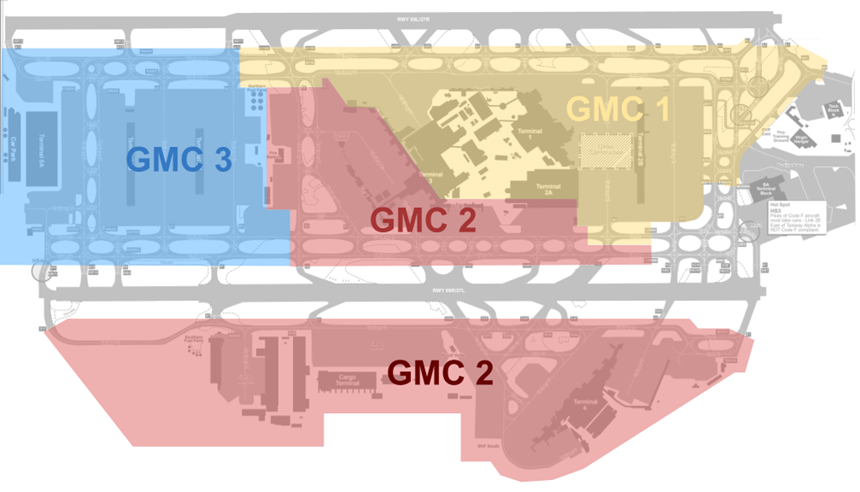
Heathrow operates with up to 3 ground frequencies. For this reason, it is important to change frequency as soon as you are asked. You can see a map of the splits below.
After the Event
Leaving Feedback
We would love to hear your feedback regarding your experience flying into Heathrow, whether it be in general or about a specific controller. You can leave feedback by following this link.
If you are leaving general feedback, put ‘All Controllers’ in the Member’s Name field.
For those members who booked a CTP slot, there will also be a chance to leave feedback on the CTP website; you will be emailed with the feedback link when it becomes available.
Any feedback, good or bad, helps us improve the event next time and we appreciate it.
Thank you for taking the time to read this briefing document. If you have any questions about the material included in this brief, please ask in the #community-help channel of the VATSIM UK Discord and a member of the CTP planning team or division staff will do their best to assist you.
We hope you enjoy the event!
Any errors in this documentation should be reported to [email protected]